Classic matchups change the teams
Scissors beat paper, paper beats rock, and rock beats scissors. Actual contact changes the losing piece’s type, and the live team counts update with every conversion.
Rock, paper, and scissors move and collide in an automatic team battle. Unlike a one-round hand game, pieces keep switching teams until only one team remains.
Enter a participant or team name for rock, paper, and scissors. Leave the fields blank to use the default team names.
Choose 5–30 pieces per team. Each team starts with the same number and movement conditions. Matching pieces begin together, with new group locations each game.
Scissors beat paper, paper beats rock, and rock beats scissors. When different types collide, the defeated piece changes to the winning type.
One remaining type wins. A short slow-motion finish and victory effect lead into the results, where you can restart with the same settings. Ending early shows the leading team or a tie by current piece counts.
Scissors beat paper, paper beats rock, and rock beats scissors. Actual contact changes the losing piece’s type, and the live team counts update with every conversion.
One piece-count setting applies equally to all three teams. Up to 90 pieces move and battle automatically.
The arena stays the same size. Large emoji make the action easy to follow, and four music tracks can play at random or stay fixed. A normal victory requires just one remaining type.
Pieces change to the winning type instead of disappearing, so the total piece count stays the same. The arena never shrinks. Matching types start together. Cheering only highlights a team; neither cheering nor playback speed changes the matchup rules.
No. This is an automatic rock paper scissors simulation with three moving teams. Instead of choosing one hand, you watch pieces change teams whenever different types collide.
The game has three teams: rock, paper, and scissors. Three participants can take one team each, or you can enter team names. Extra matchup rules for four or more teams are not implemented.
No. A single count keeps the starting numbers equal. Each team starts with 5–30 pieces, for 15–90 pieces in total.
Scissors beat paper, paper beats rock, and rock beats scissors. On contact between different types, the losing piece changes to the winning type.
No. Cheering only highlights the selected team. It does not change movement, collisions, or winning rules.
It is an early end. The team with the most pieces is shown as leading, or tied leaders are shown if the highest counts match. A normal final win requires only one type to remain.
Yes. Restart with the same settings from the results. Desktop and mobile browsers and fullscreen are supported, with no installation or payment required.
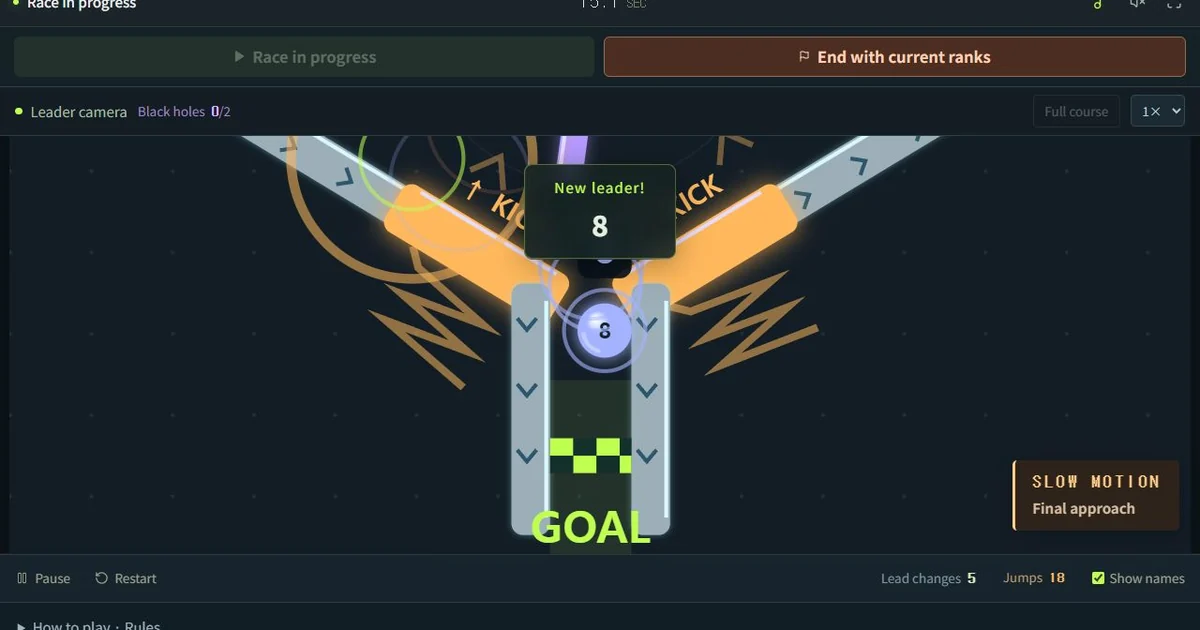
Add names and watch them become marbles. Bounces, jumps, and last-second twists decide your winners.
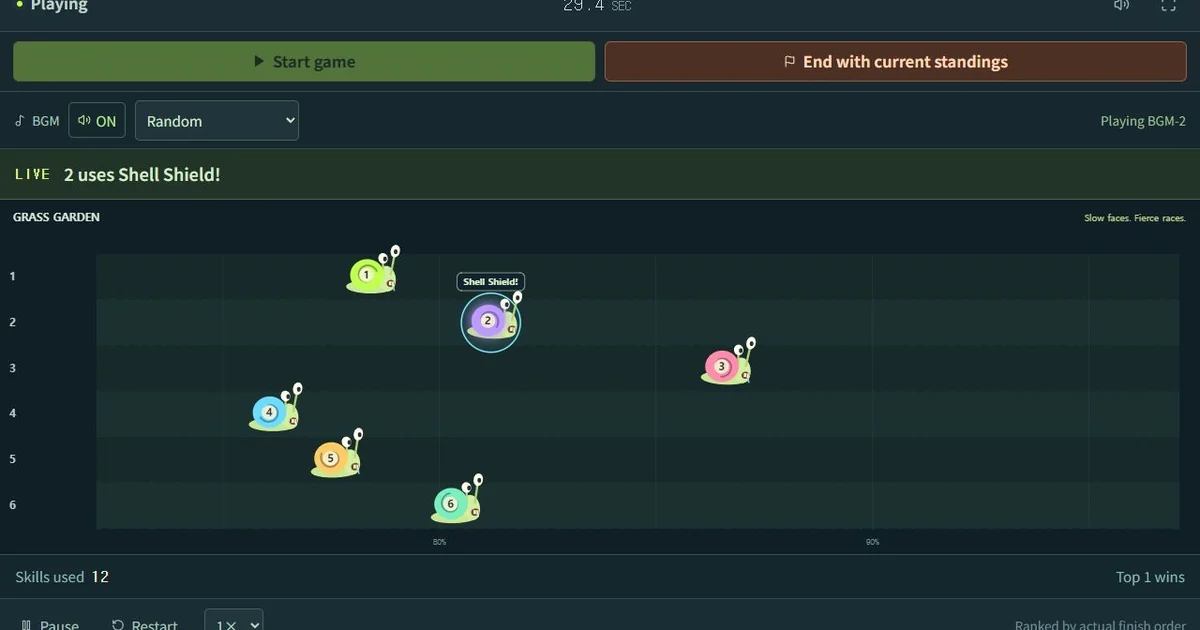
Slow snails, fast reversals. Salt, hooks, position swaps, and motorcycle charges turn the race upside down.